
Hospitality · Hotel ERP
Most hotel software runs your rooms. This one runs your hotel.
Front desk, restaurant, housekeeping and transport — and the accounting, payroll, stores, purchasing and maintenance behind them. Odoo Hotel is a hotel management system built on the ERP the rest of the world already runs on. One database. One supplier. Your website included.
The part nobody quotes for
Rooms are a third of your hotel. Most software only sees that third.
Every hotel system handles reservations, room status and billing well enough. That is the easy third, and it is where the market stops.
The rest of your hotel is a restaurant with a food cost, a store with stock in it, a payroll, a maintenance schedule, a fleet, a supplier ledger and a set of accounts. Software that ignores all of that isn't managing your hotel. It's managing your rooms, and leaving you to run the business on spreadsheets, WhatsApp and memory.
Odoo Hotel starts from the whole business. The front desk is one department in it — not the entire product.
From enquiry to invoice
Nine departments. One guest record. No re-typing.
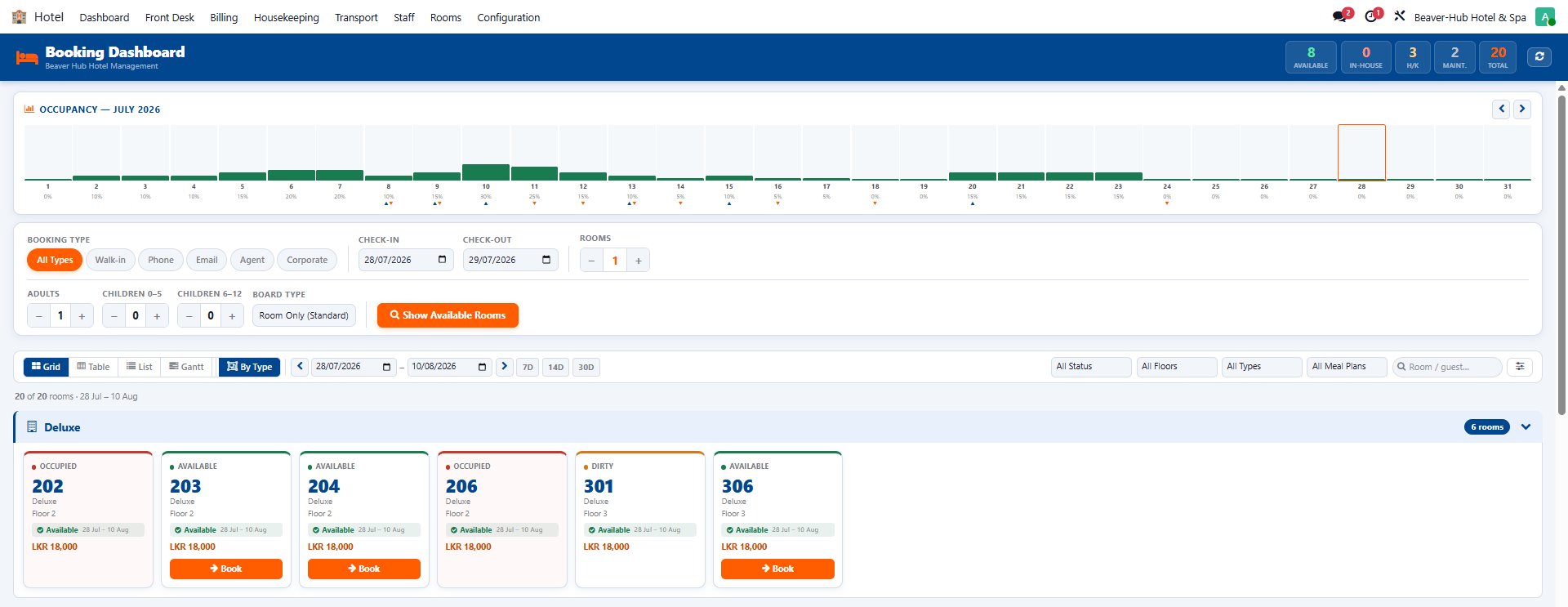
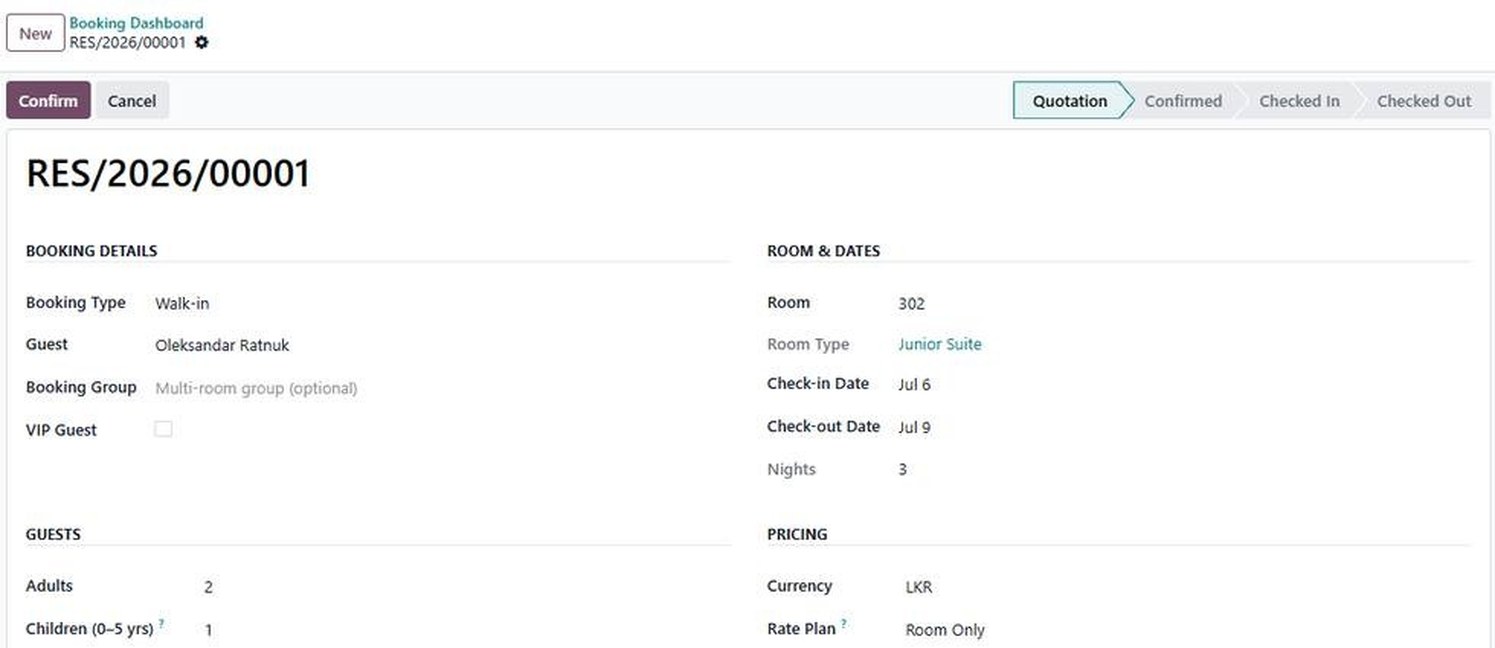
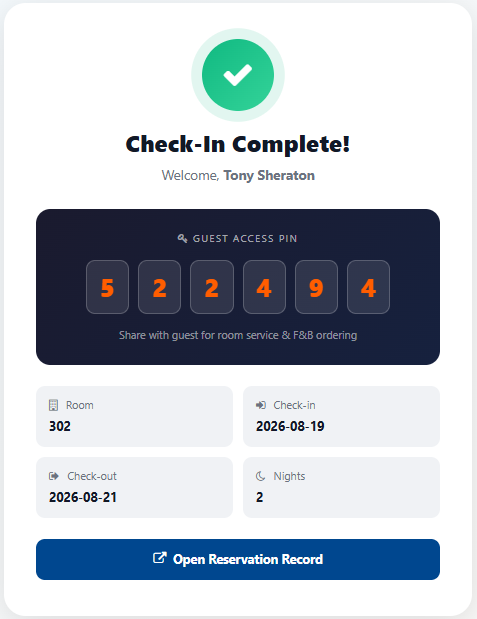
A guest books on your website or at the counter, with availability, rate and room status on one screen. Check-in captures identity, allergies, celebrations and the airport pick-up in a single pass — and every department that needs one of those facts already has it.
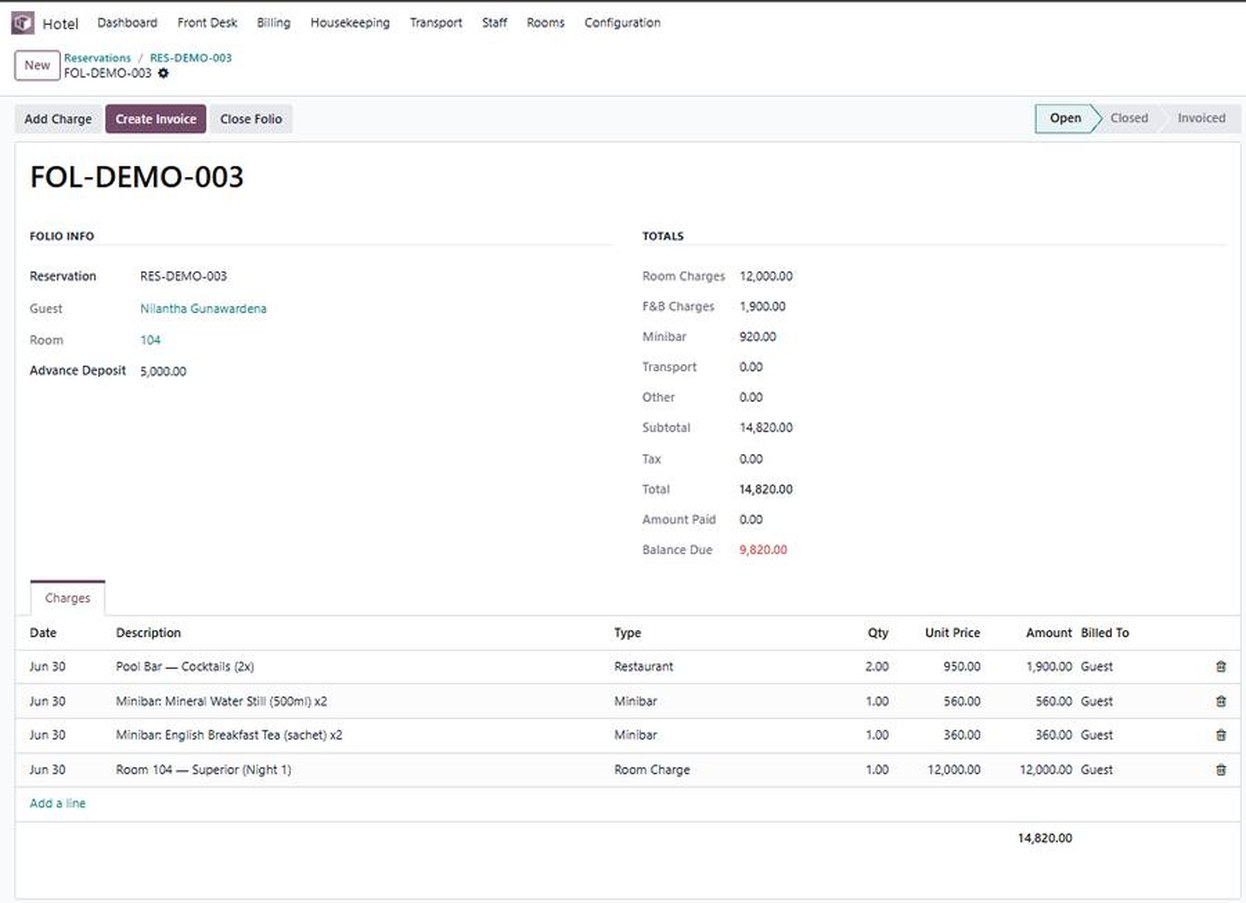
Check-out raises the housekeeping task on its own. Every charge — restaurant, minibar, transport, add-ons — lands on one folio, the invoice generates from that folio, and the revenue is already in your accounts, split by outlet, before anyone has opened a spreadsheet.
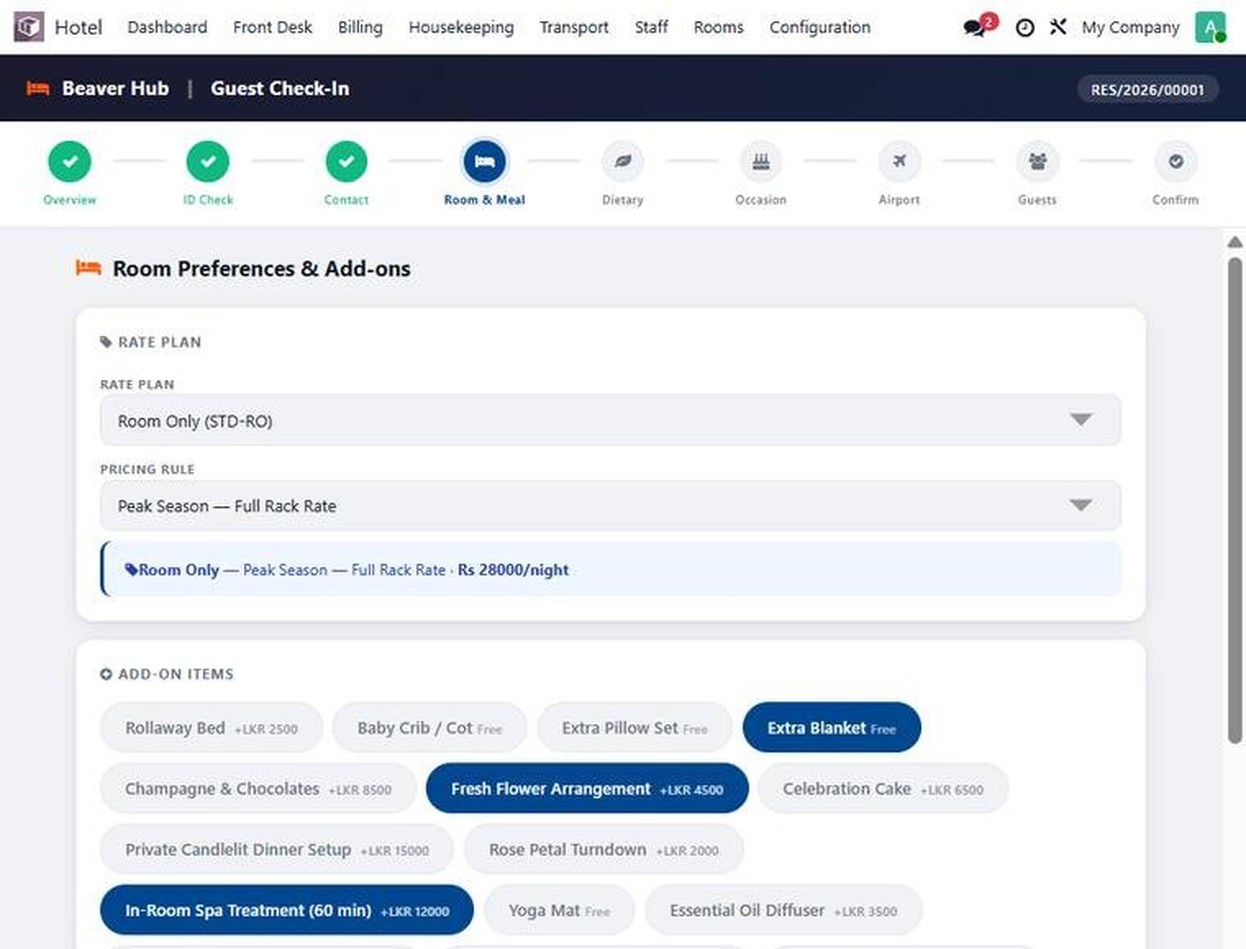
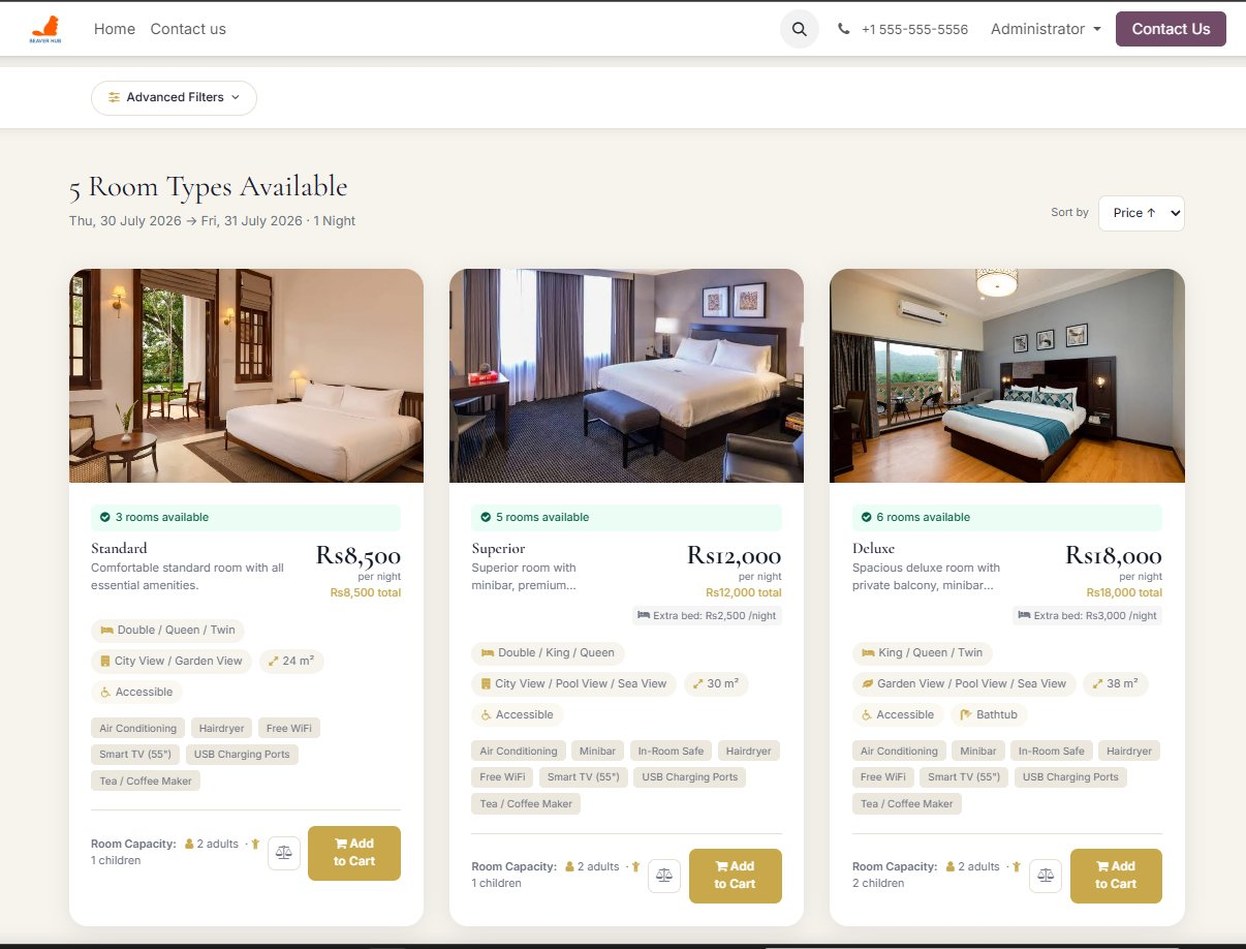
Restaurant, bar and room service
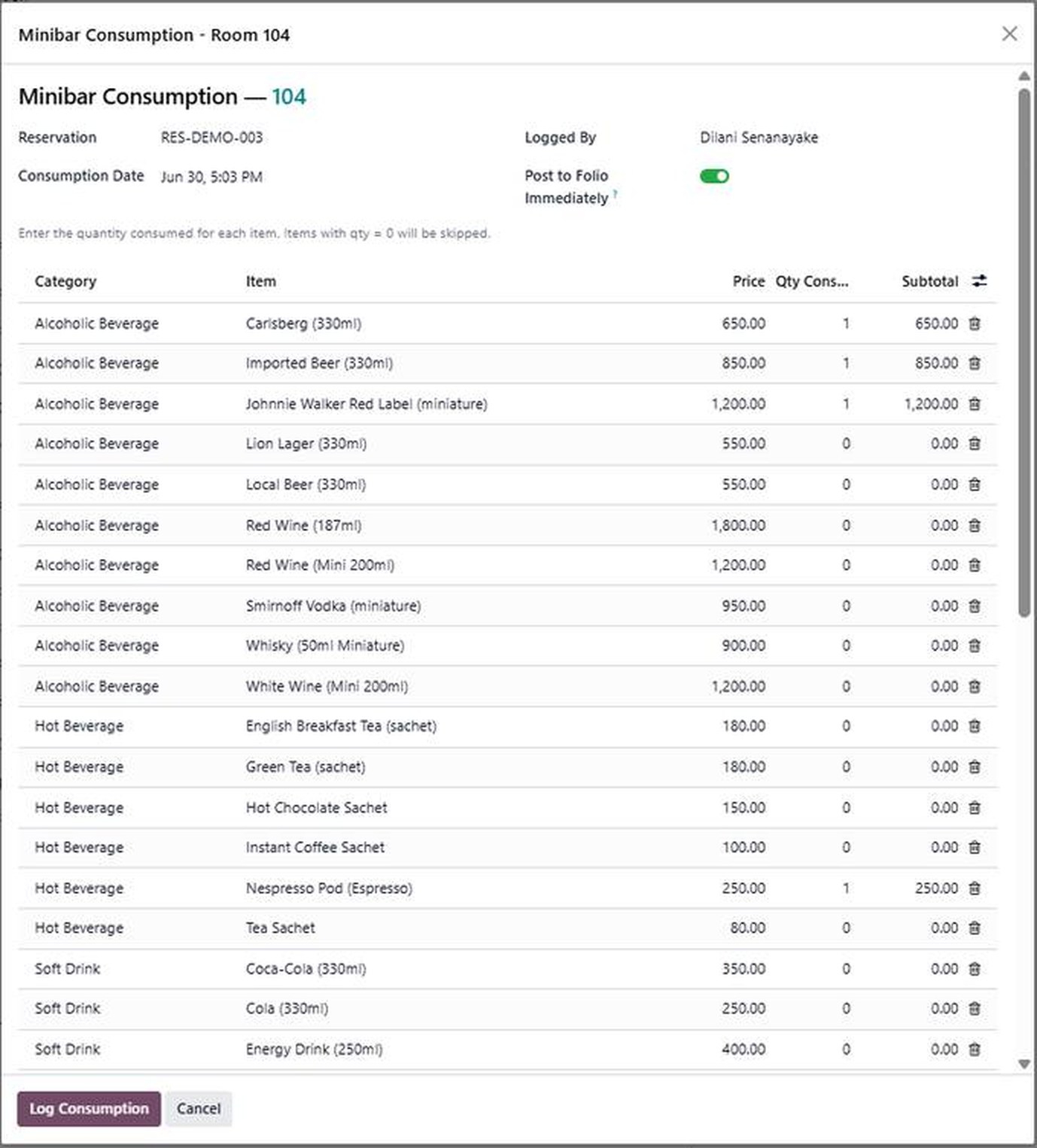
Count the hands a drink passes through before it becomes money
In most hotels this is a phone call. A waiter reads a room number to reception, who writes it on a chit and keys it in later — if the chit survives the shift. Every red step below is a point where revenue you have already served can quietly stop moving.
The back office
Ask where your numbers live. Count how many answers you give.
Partly in the PMS. Partly in a till. Partly in a spreadsheet on somebody's laptop. Fully understood about three weeks after the month has ended.
That is not a software problem you fix with an integration. It is what happens when the system that runs your rooms was never designed to run your business.
Odoo Hotel removes the handoffs because there are none to remove. Room revenue, F&B, minibar, transport and add-ons post to your accounts as they are charged. The purchase order, the stock, the payslip and the maintenance job are in the same database as the reservation — because Odoo is an ERP, and hotels are the shape of business ERPs were built for.
It's sold as a hotel management system. It behaves like an ERP.
Odoo Hotel runs on Odoo Enterprise — the ERP used by millions of businesses worldwide, configured for a hotel. Everything below is part of the system, in the same database as your reservations, not a separate product bolted to the side.
Full accounting
Every transaction journals itself as it happens. No month-end catch-up.
Bank reconciliation
Statements match themselves against your invoices and bills.
Tax & receivables
VAT report fed automatically. Aged receivables live, not reconstructed.
Profitability by outlet
Find out whether the restaurant and the spa actually make money.
Fixed assets & loans
Depreciation and loan splits generated each period, without a schedule in Excel.
Payroll & rostering
Payslips from actual attendance. Shifts built and emailed to the team.
Dashboards & e-signature
Occupancy against cost, live. Contracts signed digitally.
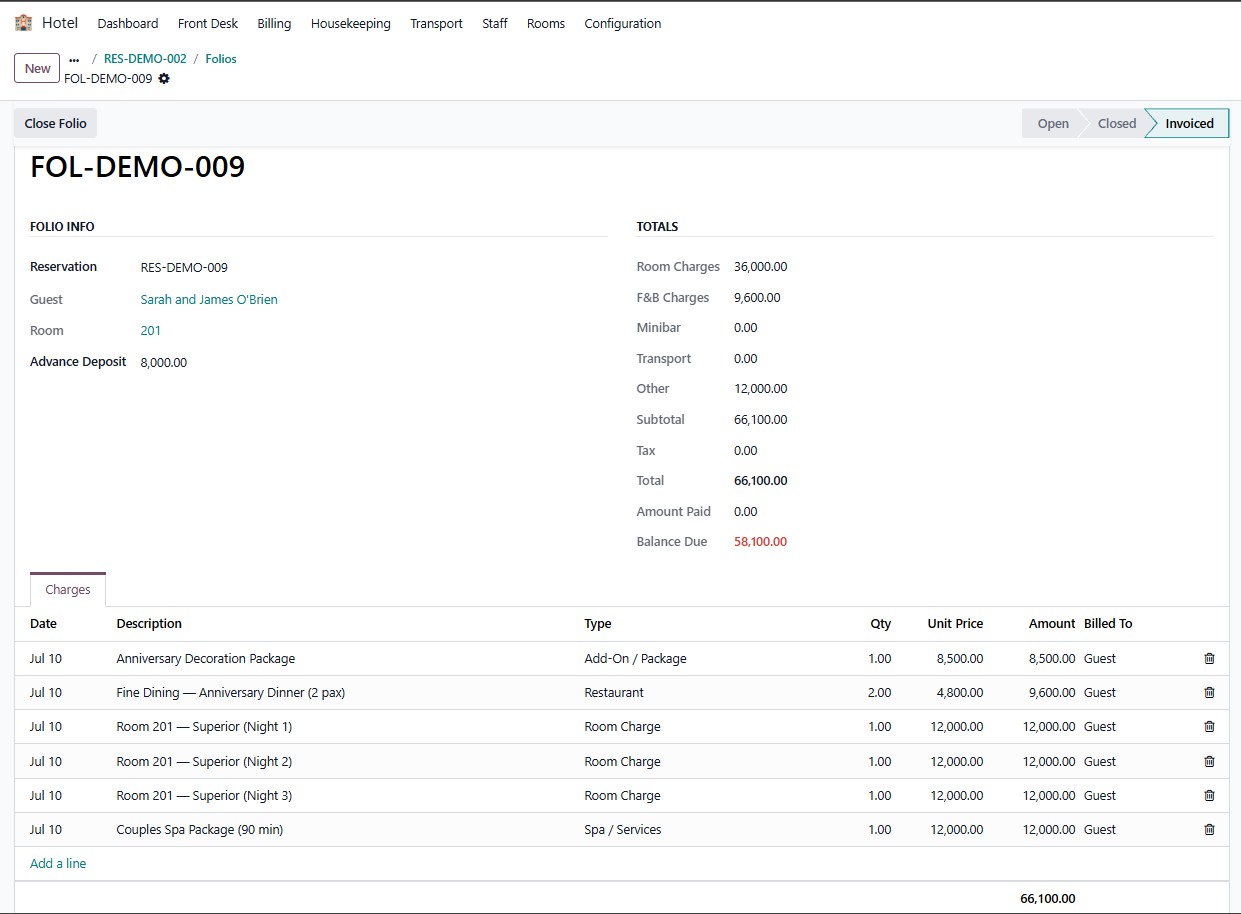
A folio is only useful if everything reaches it
The restaurant posts from the till. The minibar posts from the room. Transport posts when the driver completes the run. Nothing waits for someone to remember.
And because it is one database, those same numbers are already in your accounts — split into room revenue, F&B and ancillary, tagged to the outlet that earned them. The management report is a report, not a project.
Find your property
Three kinds of hotel. Three completely different ways money leaks.
The same system, configured for what actually goes wrong at your size.
The operational depth of a chain, without the headcount
When the owner is also the duty manager, the finance department and the person chasing the laundry.
Independent properties don't lose money in one big place. They lose it in twenty small invisible ones — a bar tab that never reached the folio, a transfer never charged, an upgrade given away with nothing to show for it, a supplier invoice paid twice because nobody had the first one.
Odoo Hotel closes those without adding a single person to the payroll.
- Restaurant, bar and minibar charges reaching the folio without a phone call
- Add-ons and room upgrades sold from the same screen as check-in
- Every charge visible on one folio at any point during the stay
- Purchasing, stock and supplier bills in the same system as the rooms
- Guest history retained across stays, so a returning guest is recognised
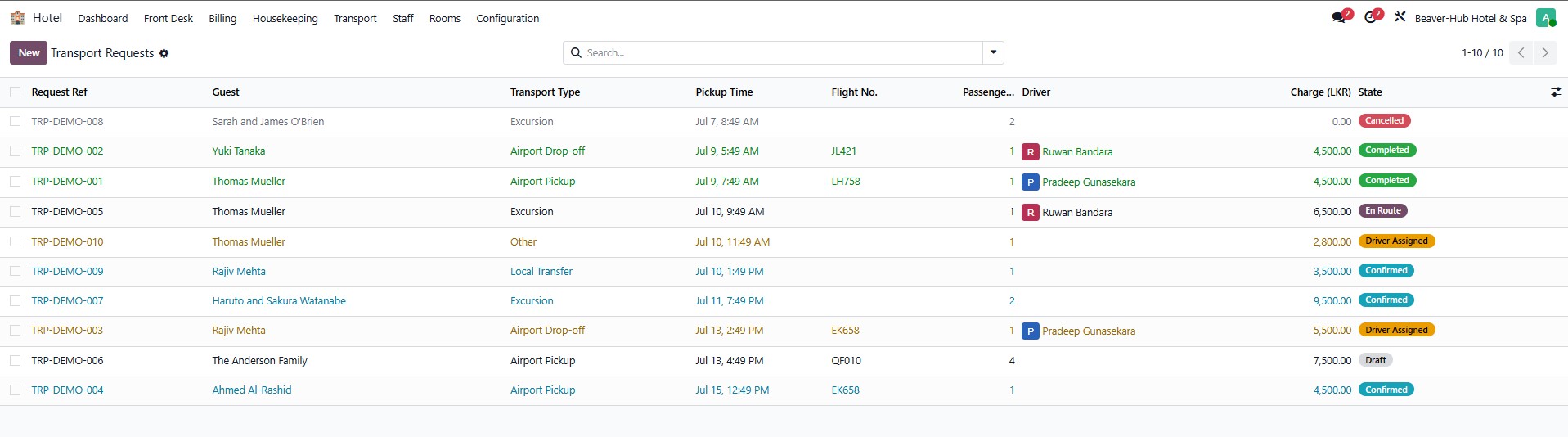
Accountability that survives the shift change
When three departments have to agree on the state of one room.
Past forty rooms, your failures stop being about capability and start being about handoff. Everyone knew. Nobody was responsible. The information was retold rather than recorded, and it degraded at every retelling.
Odoo Hotel makes the handoff explicit — assigned, acknowledged, timestamped and owned.
- Two-way shift handover that isn't closed until the incoming manager accepts it
- Incident register with severity, owner and status
- Housekeeping board with priority, assignment and a verification stage
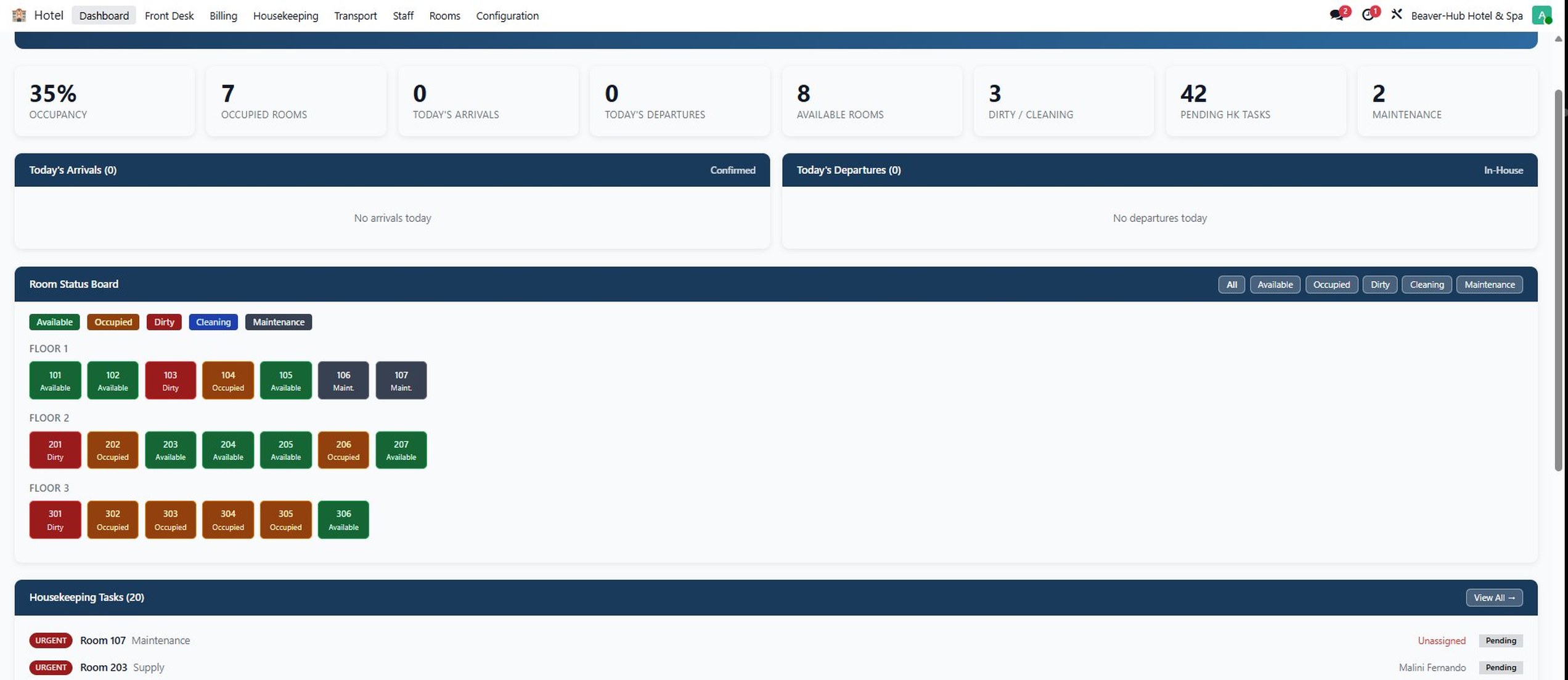
- Room status by floor, on one board, for the whole property
- Multiple properties from a single login, with each one's numbers separate and the group's numbers consolidated
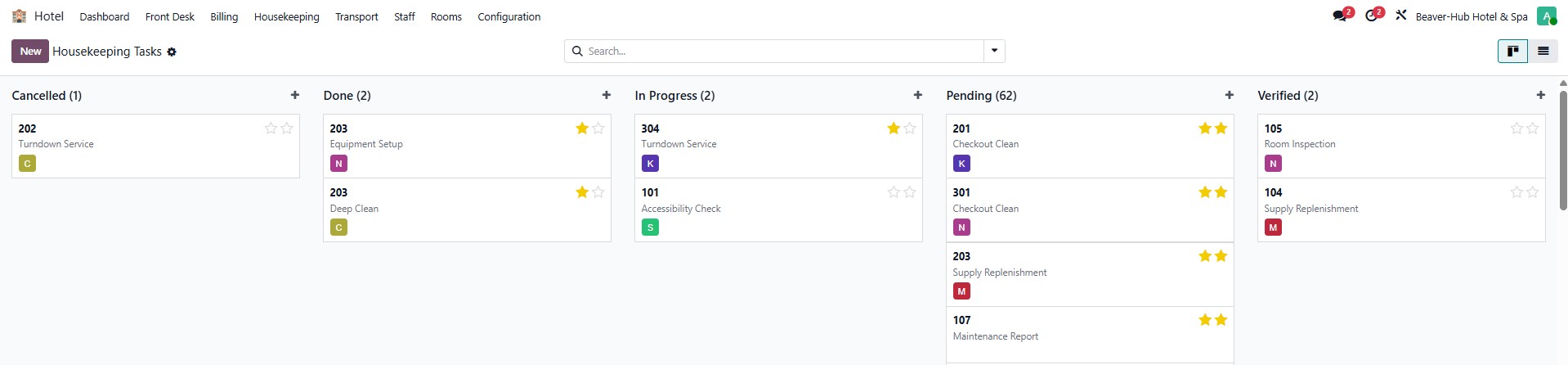


Fifty arrivals, one coach, one queue, one first impression
The lobby at 3pm is the entire review.
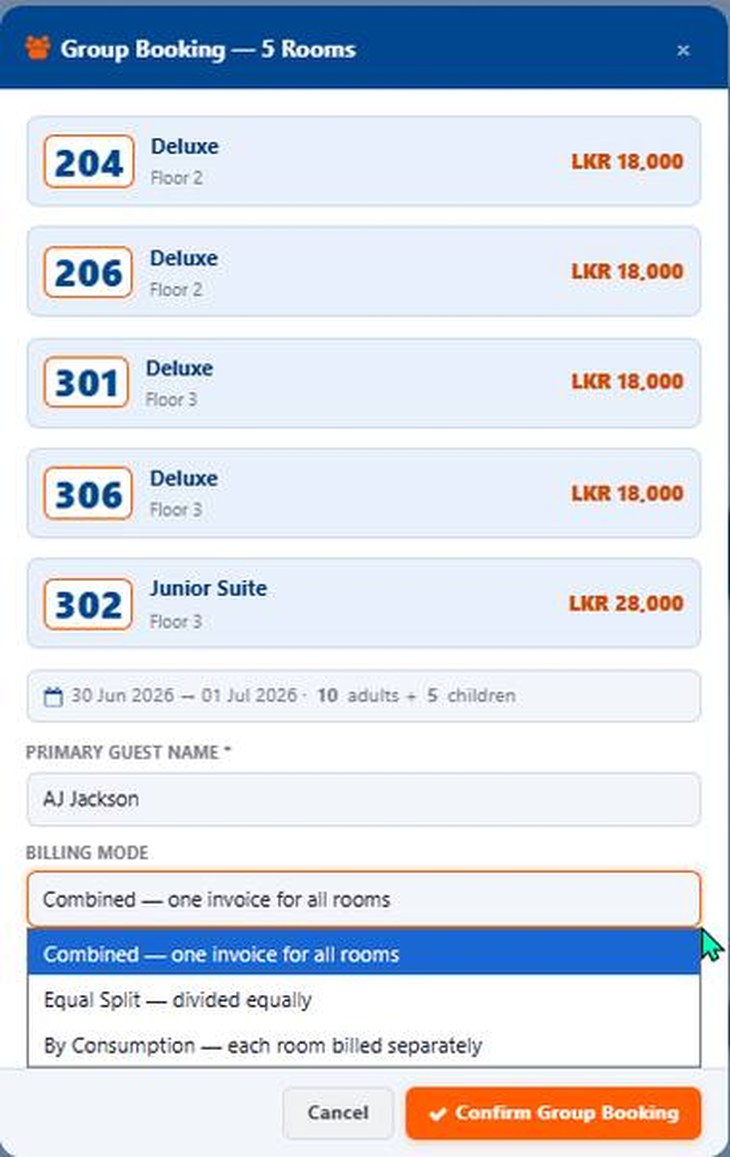
Resorts absorb group arrivals, airport runs, multiple outlets and dietary complexity that a city property never sees — and all of it at once. Bulk check-in processes the whole coach together instead of fifty separate transactions at one desk.
- Group booking with three billing modes: combined, equal split, or by consumption
- Transport queue sorted by pickup time, with driver and vehicle allocated
- Flight number, arrival time and luggage count captured at check-in
- Multiple F&B outlets posting to the correct folio under the group's billing mode
- Preventive maintenance scheduled by asset, so the pool pump is serviced before the season, not during it
Guest safety
The allergy reaches the kitchen. Without anyone remembering to walk it over.
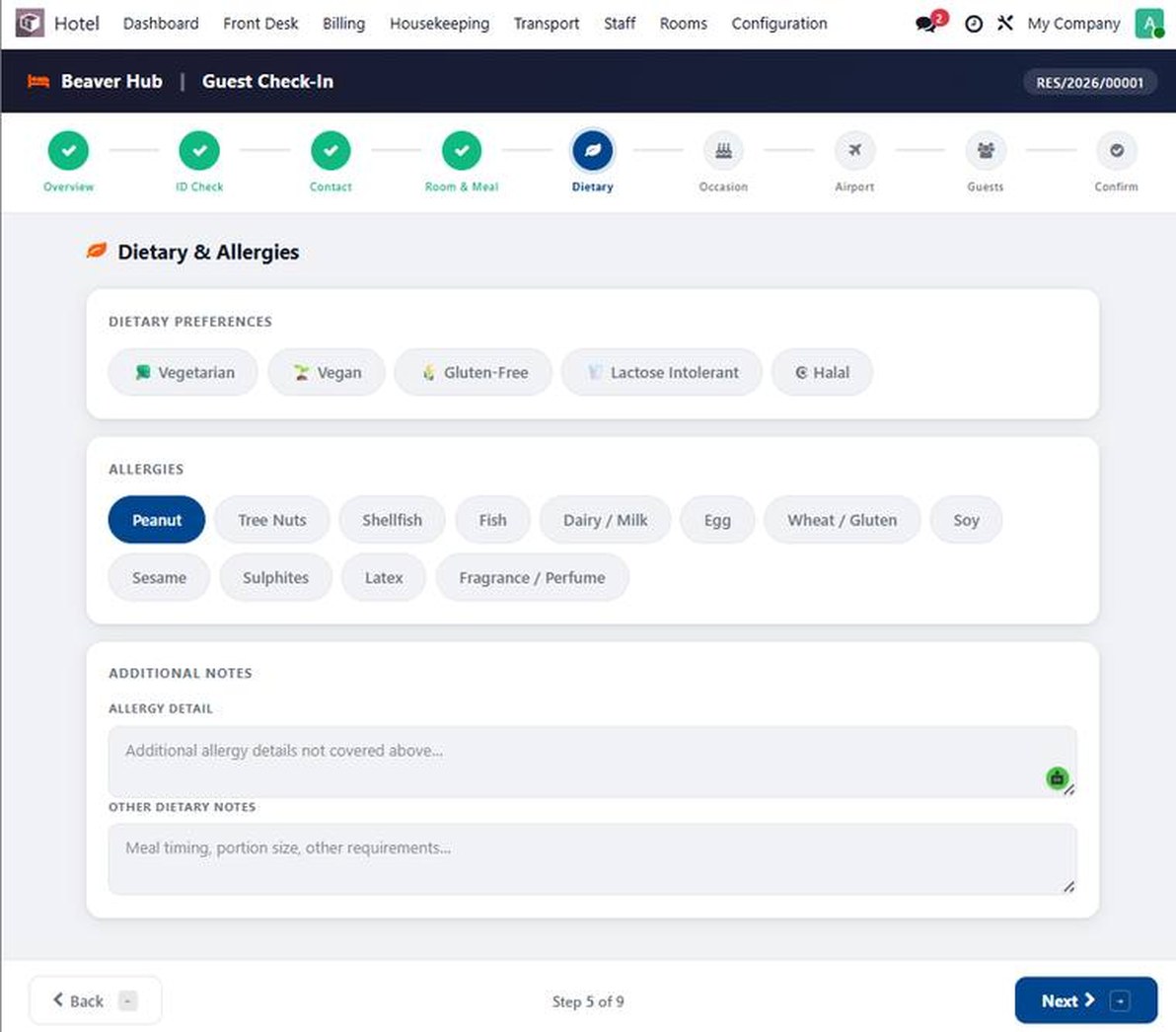
Most systems can store a dietary preference. Storing it is not the same as acting on it. In practice it gets written on a card, mentioned at the desk, and reaches the restaurant only if the person who took it happens to still be on shift.
Odoo Hotel captures it as structured data at check-in and pushes it to the departments that need it — visible against the guest before the order is taken, not discussed after.
This is the difference between a system that records what you told it and a system that does something about it.
Before the detail
Where we lead, where we match, and where we're going next
Every vendor has all three. Most only show you the first.
- Accounting, payroll, purchasing and stores on the same database as the reservation
- Allergy and dietary routing to housekeeping and the kitchen
- Transport with driver and vehicle allocation
- Shift handover with acknowledgement, and an incident register
- PIN verification on a room charge
- Preventive maintenance scheduled by asset
- Front desk, housekeeping and billing in one system
- Direct booking engine on your own website
- Rate plans and seasonal pricing
- Folio and integrated invoicing
- ID capture and compliance at check-in
- Multiple properties from a single login
- OTA channel management across hundreds of channels
- Algorithmic and AI-driven room pricing
- Metasearch and GDS connectivity
Three gaps, all in the same place: distribution. If that is what decides this for you, the established platforms are ahead of us today.
The comparison
How we compare, including where we don't
We reviewed five leading hotel systems in April 2026, feature by feature. Here is the result, with the rows we lose left in.
| Capability | Odoo Hotel | Cloudbeds | Oracle OPERA | Mews | SiteMinder | RoomRaccoon |
|---|---|---|---|---|---|---|
| Front desk, housekeeping and billing in one system | Yes | Yes | Yes | Yes | Needs a PMS | Yes |
| Restaurant and bar point of sale | Built in | Via marketplace | Native MICROS | Native Mews POS | Not offered | Via Lightspeed |
| Restaurant charges post to the room folio | Yes | Via third-party POS | Yes | Yes | Not offered | Via Lightspeed |
| Guest PIN verification on a room charge | Yes | Not offered | Not offered | Not offered | Not offered | Not offered |
| Accounting, payroll, purchasing and stores on the same database | Same database | External | External | External | Not offered | External · Sage |
| Preventive maintenance scheduling | Built in | Third-party CMMS | Maintenance module | Not evidenced | Not offered | Not evidenced |
| Direct booking engine on your own website | Yes | Yes | Yes | Yes | Ranked #1 globally | Yes |
| Allergy and dietary alerts routed to housekeeping and F&B | Yes | Not offered | Not offered | Not offered | Not offered | Not offered |
| Airport transfer management with driver and vehicle allocation | Yes | Not offered | Not offered | Not offered | Not offered | Not offered |
| Shift handover with acknowledgement, and incident register | Yes | Not offered | Not offered | Not offered | Not offered | Not offered |
| Multi-property from one login | Yes | Enterprise plan | Core strength | Yes | Yes | Small groups |
| OTA channel manager | Planned | 300+ channels | Via OXI | Via integrations | 450+ channels | 300+ channels |
| Automated AI pricing | Planned | Signals AI | Via IDeaS / Duetto | Built-in RMS | Dynamic Revenue Plus | RaccoonRev |
Competitor capabilities per our April 2026 review of Cloudbeds, Oracle OPERA Cloud, Mews, SiteMinder and RoomRaccoon (Hotel Tech Report, Capterra, G2, vendor documentation). "Via X" or "External" means delivered through a separate connected product. Vendors change. Verify directly before you decide.
Straight answer · what we don't do yet
Two things we can't do, and one reason we're telling you
If OTA distribution across hundreds of channels or algorithmic pricing is what decides this purchase, established platforms are ahead of us today. We would rather you heard that from us now than found it out in month three.
- Planned
OTA channel managementOn the roadmap. No vendor announced, no date promised.
- Planned
Automated AI pricingRates are configured by you today, not set by an algorithm.
Everything else on this page is running in production. If a vendor's comparison page has no third column, ask them why.
Anything we haven't answered? Call +94 76 664 6664 and ask us directly.
Before you ask
The questions we get every time
Why an ERP? We just need a hotel system.
Because you don't just run a hotel. You run a restaurant with a food cost, a store with stock in it, a payroll, a maintenance schedule, a fleet and a set of accounts. A hotel system manages the rooms and hands you back the rest as spreadsheets. An ERP manages the business, and the rooms are one department in it. You can buy a hotel system and then buy an accounting package, a POS, a payroll tool and an inventory tool, and pay someone to keep the five of them talking. Or you can buy one system where they were never separate. That's the whole argument.
Does it really include accounting and payroll?
Yes — not connected to them, running on them. Odoo Hotel is built on Odoo Enterprise, so full double-entry accounting, bank reconciliation, VAT, aged receivables, fixed assets, payroll, attendance, staff rostering, purchasing, inventory, maintenance, dashboards and e-signature are part of the same system as your reservations. Room revenue posts to the ledger as it is charged, tagged to the outlet that earned it. There is no export, no import, and no month-end reconciliation between two products. Licensing is per user, direct from Odoo, and we quote it separately and openly.
Can the restaurant charge a bill to a guest's room?
Yes. The waiter selects Charge to Room at the point of sale, enters the room number and the guest's access PIN, and the bill posts to that guest's folio immediately as a restaurant charge — against the right outlet, in your accounts, the moment it happens. No phone call to the front desk, no paper chit, nothing to reconcile at month-end. The PIN verification is custom to Beaver Hub; it is not standard software.
Do you connect to Booking.com and the other OTAs?
Not today. OTA channel management is on our roadmap and we have not announced a vendor or a date. If distribution across hundreds of channels is your priority right now, the established platforms are ahead of us on that specific capability, and we would rather tell you before you sign than after. What we do give you is a commission-free booking engine on your own website, and every direct booking it takes is revenue you keep in full.
Can we run more than one property?
Yes, from a single login. Each property keeps its own rooms, rates, staff, stock and accounts, and the group sees consolidated numbers across all of them. You don't log out of one hotel to look at another, and you don't wait for someone to merge three spreadsheets to find out how the group performed.
Who actually built this, and why should we trust it?
Beaver Hub (Pvt) Ltd, a Sri Lankan software company specialising in process improvement, operations management and ERP implementation, and an official Odoo partner. Before we wrote a line of specification we documented 202 operational problems across 22 domains of hotel operations and reviewed five competing systems feature by feature. That background is the reason this product covers the back office at all — a company that only knew front desks would have built another front desk. Ask us to show you the research and we will send it.
Do we own our data?
Yes. The database is yours and you can export it in full at any time. You are not locked into us as a supplier in order to keep operating, and that is a deliberate choice on our part. It is also worth asking every vendor on your shortlist the same question, and noticing which ones need a moment before answering.
How long does implementation take?
It depends on the size of the property, the number of outlets, and whether you're migrating history. We scope it properly before quoting rather than giving you a number we'd have to walk back later. Ask for the timeline in writing as part of your proposal — from us and from everyone else you're talking to.
The bar tab that vanished. The transfer nobody charged. The month-end that took three weeks. Tell us yours and we'll show you, live and on your own numbers, what happens to each one. Thirty minutes. No slide deck.
Book a demo →